

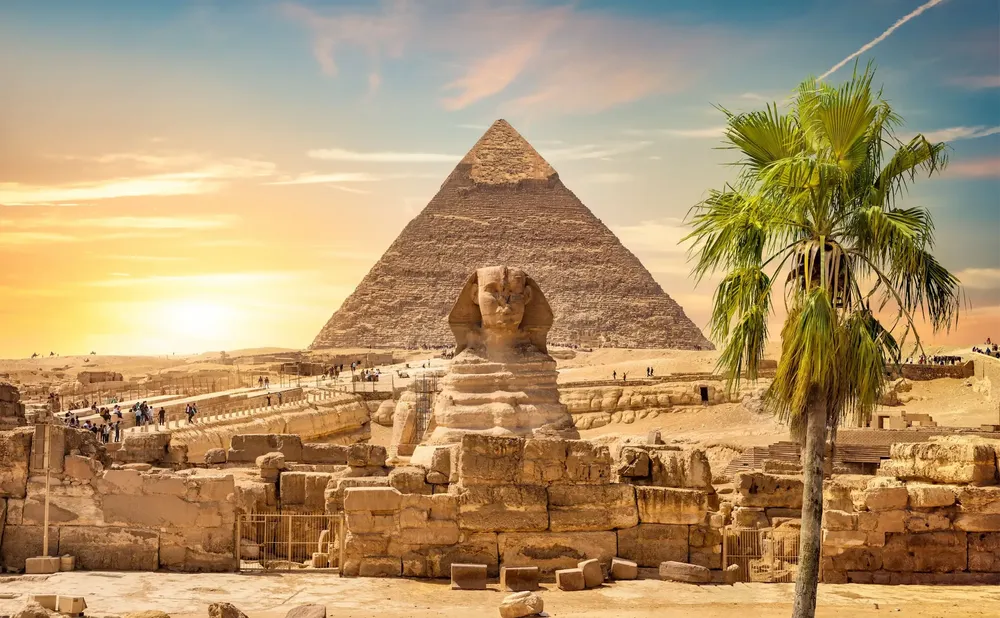
The Great Sphinx of Giza: Sentinel of the Desert
On the edge of Cairo, amid the golden sands of the Giza Plateau, stands one of the world's most recognisable ancient monuments: the Great Sphinx. With the body of a lion and the head of a human, this colossal sculpture continues to evoke the power, artistry and mysteries of ancient Egypt.
A history more than 4,500 years old
The Sphinx was carved directly from the natural limestone bedrock during Egypt's Old Kingdom, most likely in the Fourth Dynasty, around the 26th century BCE. Egypt's Ministry of Tourism and Antiquities notes that archaeological evidence strongly connects its construction with the reign of Pharaoh Khafre. The precise date and original purpose, however, remain subjects of scholarly discussion.
The monument stands beside the Valley Temple associated with Khafre and near the lower part of the causeway leading towards his pyramid complex. Its location links the Sphinx closely with the royal monuments of the Giza Plateau.
The meaning behind the human head and lion's body
In ancient Egyptian symbolism, the lion represented strength, authority and royal power. The human head is generally understood as a royal image, often associated with Khafre. Together, these features are commonly interpreted as an image of the king's power and a guardian of sacred space.
Facing east, towards the rising sun, the Sphinx measures approximately 73 metres (240 feet) long and 20 metres (66 feet) high. It is among the oldest and most celebrated monumental sculptures to survive from the ancient world.
Buried by sand: the Dream Stele
Over thousands of years, wind, sand and weathering affected the monument. At various points in history, much of the Sphinx was buried beneath desert sand.
A famous account of its rediscovery appears on the Dream Stele, erected between the Sphinx's front paws by the future pharaoh Thutmose IV during the 18th Dynasty. The inscription tells a story in which the young prince dreams that the Sphinx promises him the throne if he clears away the sand covering the monument. Whether read as history, royal ideology or legend, the story shows how deeply the Sphinx had entered Egyptian religious and cultural life.
What happened to its nose?
The Sphinx's missing nose has inspired countless stories. Some popular explanations blame a specific act of destruction, but claims about exactly who removed it and when are not securely established by reliable evidence. Centuries of exposure, damage and restoration have all shaped the monument we see today.
What to look for when you visit
- The front view: take in the human face, the lion's body and the scale of the sculpture.
- The setting: look at the relationship between the Sphinx, Khafre's Pyramid and the surrounding temples.
- The Dream Stele: notice the inscribed monument positioned between the Sphinx's paws.
- The light: early morning and late afternoon often bring out the warm tones and textures of the limestone.
Travel tips
The Great Sphinx is located on the Giza Plateau, near Cairo, within the same archaeological area as the famous pyramids. Many visitors combine it with a visit to the pyramids in a single day. Ticket categories, opening hours and access arrangements can change, so check the latest official information before travelling.
The Great Sphinx is more than a monumental statue. It is a remarkable survivor of the ancient world, standing in the desert for millennia and keeping some of Egypt's greatest stories alive.